George Russell (right, with Kimi Antonelli) won the sprint race in Canada but then retired from the grand prix the following day
George Russell says this year’s world championship is Kimi Antonelli’s “to lose” after the Briton’s retirement from the last race in Canada.
Russell heads into this weekend’s Monaco Grand Prix with a 43-point deficit to his Mercedes team-mate after the Briton’s engine failed while leading in Montreal.
Italian Antonelli, 19, has won four races in a row, while Russell’s only grand prix victory this year was in the season-opening race in Australia.
Monaco is the sixth round of what is now a 22-race season.
“If I look at it from my competitor’s position, you’re kind of in a position now that you’ve got such a buffer, it feels like you can only keep it or you can only lose it,” Russell said.
“It’s his to lose. My mindset is to enjoy every single race, try and win every single race, the same as I’ve done this whole season. I’m going to fight the same, I’m not going to change my mentality at all, nor am I going to let this put any more pressure on to me.”
Antonelli rejected Russell’s reasoning. “I don’t really give weight to that line,” he said, “because it’s still so early in the season. I continue trying to excel, trying to maximise the car and see where we end up at the end of the season.
“It’s difficult to think you can lose something when you don’t have the championship. How can I lose it when I didn’t win it yet?”
Russell, 28, has bemoaned a series of events going against him – including technical issues in qualifying in China, a safety-car intervention in Japan that handed the lead to Antonelli and the Canada problems – but says he has no reason to feel he cannot bounce back.
“I don’t feel like I need to get every single result possible, because the season’s long enough that over the course of the season, it will swing if you’re the guy who’s on top,” he said.
“So I just need to continue being the guy who’s coming out on top, even if he’s the one at the moment who’s getting the results.”
Russell said that his retirement in Canada “hurts” but added: “That’s just the way racing goes.”
And he pointed to his own junior career as a reason to stay positive.
“In Formula 2 (in 2018), I had, I think, five failures over the course of a year,” he said.
“I came to Monaco, never been to Monaco before, and I broke down on the out lap in practice. And then went into qualifying, 15-minute session, four laps, and didn’t qualify anywhere decent.
“I broke down on other occasions. The engine stalled, but then still went on over the course of a year to win the championship.
“So I take inspiration from those moments. And I think for everyone every year, you have a run of races where, I don’t know why or how, everything just goes your way.
“And that’s just how it goes sometimes when things turn. It’s just a mentality I’ve got. I’m in a very good head space. The pressure feels off now. And there’s just a huge amount of time to go.”
Antonelli, who is in only his second season in F1, added: “I don’t feel that much pressure. I feel pretty relaxed. I just keep doing what I’m doing, trying to raise the bar.
“George is a super-strong team-mate and he will make my life difficult.”
Will Mercedes face a challenge?
Mercedes have won every grand prix this season, and the only time they have been beaten to pole or a victory was by McLaren’s Lando Norris in the sprint in Miami.
But they are expecting to face a tough challenge, particularly from Ferrari but also McLaren, on the famous street circuit this weekend.
Ferrari’s car is good in the corners, and its engine deficit will be less pronounced in Monaco, which is the least power-sensitive track on the calendar. McLaren’s chassis is strong in slow-speed corners.
Antonelli said: “Miami is a race where we expected it would be difficult and Monaco is another. Ferrari has historically always been quick here, even when they did not have a fast car. I wouldn’t be surprised if they were quick, and I think McLaren can also be quick.”
Ferrari’s Lewis Hamilton is fresh from his best result yet for the Italian team, a second place in Canada, and said: “This track would probably bode better for us than some of the others. The long straights, we lost quite a lot of time, so obviously here we would lose a lot less and I don’t think power is going to be necessarily so much of an issue. And our car is good in low speeds so I think we’ll be competitive.
“I don’t think we’ll necessarily be the quickest, especially because after the Mercedes upgrade at the last track they were quite quick through the low speeds. But I think we’ll be competitive.”
Norris said he unsure about McLaren’s potential in Monaco but added: “It’s true that the Ferraris are not the quickest on the straights, but that’s also because they have a lot of downforce and a lot of drag.
“So it’s kind of their own punishment they give themselves, which gives them some advantage. That advantage will definitely show this weekend.”
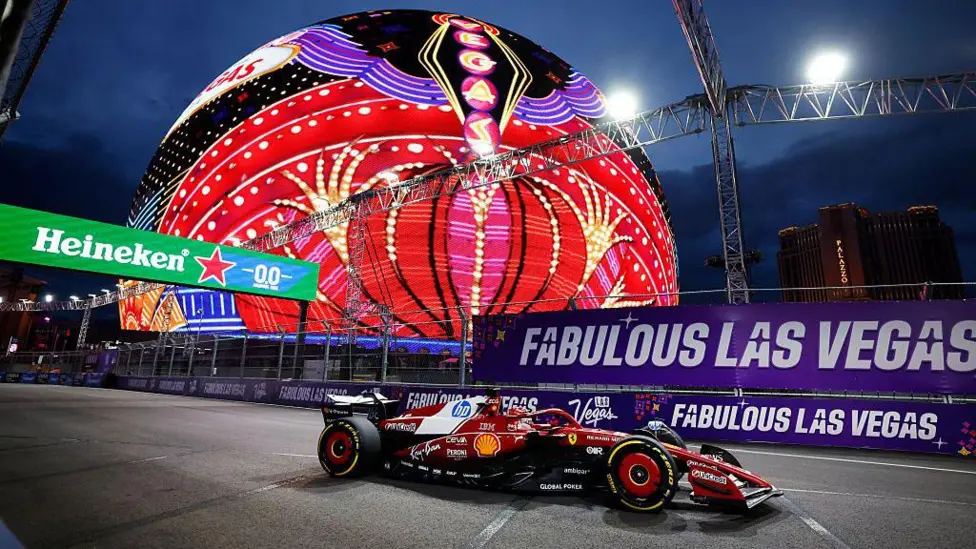
This season’s race weekend in Las Vegas takes place from 19-21 November
Formula 1 is to race in Las Vegas until at least 2037 after extending its contract with the city by 10 years.
The first race in Las Vegas in 2023 was the culmination of 40 years of on and off attempts to secure a race there that incorporated the famous Strip into the track layout.
F1 was so determined for the race to become a success that it invested $500m in buying a plot of land in the centre of Las Vegas on which it constructed a new pit building and paddock.
Stefano Domenicali, the F1 president and chief executive officer, said: “We are thrilled that Formula 1 will continue racing in Las Vegas for many years to come.
“We always believed that Las Vegas would become a cornerstone of our presence in the United States, and this extension, together with the success of recent years, reinforces our long-term commitment to this important market.”
F1’s willingness to invest its own money in Las Vegas was a key factor in convincing the city to back the event, and to allow it to run down the Strip in front of the famous casino hotels.
The event has proved a major success for Las Vegas, turning what had been its least profitable weekend of the year, the one before Thanksgiving, into one of its most lucrative.
A statement from F1 said that since 2023 the grand prix had delivered $3.2bn (£2.4bn) in cumulative economic impact for Las Vegas, with the 2025 race alone generating $43m ($32m) in tax revenue for the city.
Steve Hill, the president and CEO of the Las Vegas Convention and Visitors Authority, said: “Extending our partnership with Formula 1 for the next decade is a major moment for both Las Vegas and the grand prix.
“In just three years, the race has become a signature global event – putting Las Vegas at the centre of culture, competition and entertainment during race week.
“As the spotlight of the world turns to Las Vegas, the event continues to reinforce our evolution as a premier sports and entertainment destination.”
Fifa has admitted an error on its website allowed 60 fans to purchase World Cup tickets for free.
Football’s world governing body has cancelled the tickets with incorrect prices, and given the affected fans the opportunity to re-purchase the tickets at full price.
“Fifa can confirm that approximately 60 fans received a communication on Wednesday, 3 June regarding tickets that had been allocated at no charge due to a prior payment issue during the checkout process,” it said, adding that it “regrets any inconvenience caused”.
Ticket Talk Network, a social media account which highlights ticketing errors, shared a letter which confirmed the fans have seven days to pay for the tickets before they are removed from their accounts.
It is understood the affected tickets were for group stage matches in Toronto.
The World Cup, which is being hosted in Canada, the United States and Mexico, gets under way on Thursday, 11 June.
The glitch is just the latest ticket issue facing Fifa, which promised the event would be sold out but still has seats available less than a week before the tournament begins.
Last week, the attorneys general of New York and New Jersey started an investigation into Fifa’s ticket practices, following allegations of “artificially inflating prices” and “misleading fans”.
Fifa is using a process it calls ‘variable pricing’ for ticket sales. It means ticket prices can be adjusted throughout the sales phases based on demand and availability.
Fifa’s final open sales window began in April. At the time it said that more tickets could be released right up to kick-off.
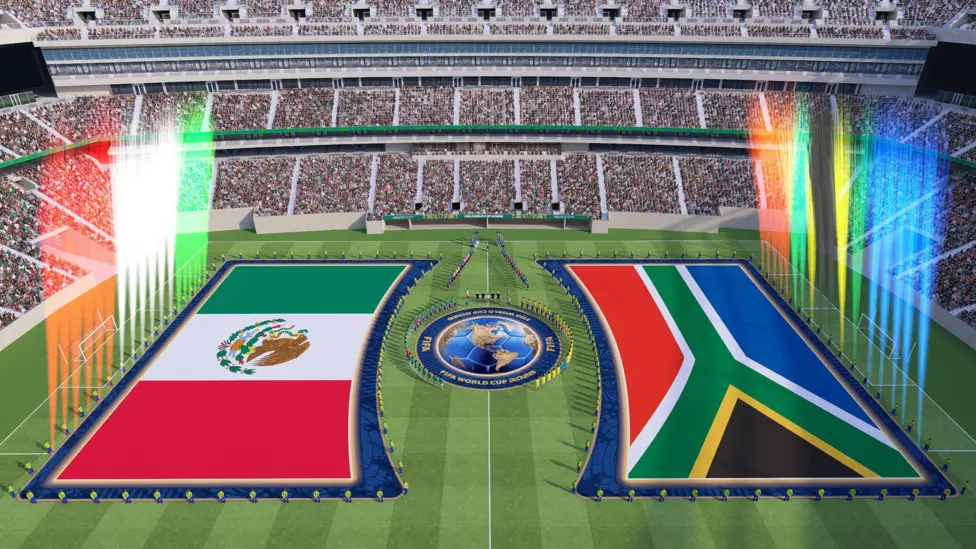
The opening match of the World Cup between Mexico and South Africa will be the debut of the new ceremony for national anthems
Fifa has unveiled what it describes as a new “unique, immersive experience” pre-match ceremony for all matches at the 2026 World Cup.
All available players in a team’s squad will gather around the centre circle for the national anthems, with extra-large country flag banners on the pitch behind them.
In previous World Cups, the starting XIs would be positioned in a line facing one of the stands with mascots in front of them.
Fifa has been eager to find a new way of introducing the players which involves the whole stadium.
For the 2025 Club World Cup, every starting player had an individual walk-on introduction. This proved unpopular because it added extra time to the pre-match formalities, and a number of games kicked off late.
Now world football’s governing body says it will create a “360-degree ceremony” which provides an “experience from every seat”.
Every player selected in the matchday squad will be joined by mascots and enter the field through a dedicated arch.
All players from both full squads, up to 52 if all are available for the match, will then come together in the centre circle for the line-ups and national anthems.
“As the Fifa World Cup grows, we continue to innovate the way the game is experienced,” said Fifa president Gianni Infantino.
“Having all players and referees face each other in the centre circle during the national anthems will create a moment of unity, pride and emotion that truly belongs to the teams and to everyone.
“The Fifa World Cup is about every player and every fan, and this new pre-match ceremony reflects that.”
Later in the tournament, the ceremony will be enhanced to include coloured smoke or pyrotechnics.
Brazil’s Kaka had just won the 2007 Fifa Player of the Year award but it was an awkward on-stage moment next to him that was to go viral and provide perhaps the first glimpse of a generational rivalry.
A youthful Lionel Messi and Cristiano Ronaldo had finished second and third respectively but Brazil legend Pele mistakenly handed the latter the trophy for second place at the Zurich Opera House.
Fifa president Sepp Blatter had to intervene to ask the duo to swap the trophies, with both looking suitably unimpressed.
For the next 10 years, Messi or Ronaldo won every Ballon d’Or and Fifa award going. In fact since 2007, 20 of the 29 gongs awarded for Europe’s player of the year has gone to one of them.
With approaching 2,000 career goals between them, 85 trophies for club and country and countless individual awards and records, Messi and Ronaldo will forever be remembered as two of the most decorated players in history.
It is a rivalry that has defined the last two decades of football, transcending clubs, countries and competitions to reshape how the game has been played, consumed and debated across the world.
“Two players like them, competing at that level for so many years, fighting over the Ballon d’Or and scoring that many goals… I don’t think we’ll see it again,” Argentina World Cup winner Angel di Maria, who played with both, says in BBC Sport’s new documentary Rivals: Messi v Ronaldo.
Driven by a pursuit of trophies, records and a relentless desire to be the best, the pair – likely to be making their final World Cup appearances this summer – have pushed each other to new heights.
It is a rivalry that goes beyond the ultimate ‘greatest of all time’ debate they have fuelled.
“They both changed football,” says Di Maria.
Ask anyone who is the greatest and agreement is hard to find.
“It has to be Ronaldo,” ex-Manchester United team-mate Rio Ferdinand says.
“Messi is the best there has ever been,” insists ex-Barcelona player and manager Xavi.
Ronaldo has had his say in the past, stating in 2012: “You cannot compare a Ferrari with a Porsche. It is a different engine. Some people say I am better, some people say he is. They are going to decide who is better in the moment and I think it’s me.”
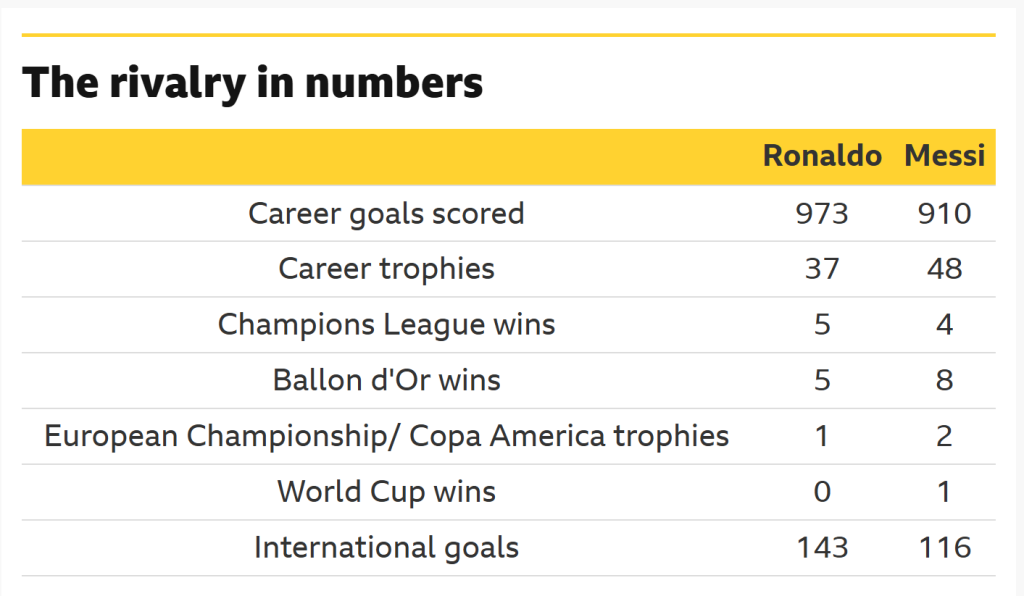
What do the numbers tell us? If it’s judged on goals or Champions League trophies, Ronaldo leads the way. If it’s Ballons d’Or or total trophies, Messi shades it.
For some, Ronaldo nudged ahead when he helped Portugal lift the European Championship in 2016, but Messi has since guided Argentina to two Copa America titles and a World Cup.
“For me, Messi is the best player in history and Cristiano is the greatest goalscorer in history,” Spanish football expert Guillem Balague says.
And Deco, who played with Ronaldo for Portugal and Messi for Barcelona, says: “They are special. They are totally different from the rest. It’s not normal to be on this level all these years.
“Each year, there’s a lot of players who do amazing things for a few years, but being almost 20 years is not normal.”
Perhaps the beauty of the GOAT debate is that it may never be settled – and does not need to be.
“They have come to appreciate each as the co-stars of the football drama they have appeared in for the last 20 years,” says Jonathan Clegg, co-author of a Ronaldo and Messi book.
The pair are seen by many as polar opposites.
The dribbler against the physical specimen. The shy genius against the arrogant ego. Pep Guardiola’s Barcelona against Jose Mourinho’s Real Madrid. Adidas against Nike.
But, while the narrative of their rivalry was undoubtedly built on their differences, the similarities between the two were striking – even from an early age.
Both players were raised in humble surroundings. Both left their homes at an early age to pursue their dreams – Messi to Barcelona from Argentina at 13 and Ronaldo to Lisbon from Madeira aged 12 – and both struggled with home sickness after leaving their family behind.
Wall Street Journal reporter Joshua Robinson, co-author of a Messi Ronaldo book, said: “Messi and Ronaldo are always portrayed as being so different but the things that forged them in their childhoods were incredibly similar.
“They both go to a place that says ‘we will take your talent and make you even greater’. That promise feels appealing but is a huge gamble. That moment of total commitment is when they realise this isn’t kid stuff any more. ‘If I’m going to be the greatest of all time, this is where it begins.’”
But the biggest thing that brought the pair together was their unshakeable desire to succeed as they quickly built reputations as prodigious young talents.
“You could already see something different with Messi,” said Xavi. “Not only the quality but the intensity with which he did things. There was an aggressiveness in attack that I had never seen before.
“Cristiano even gave him an extra push to be a better player.”
Meanwhile in England, a teenage Ronaldo was signing for Manchester United from Sporting.
“I never met a young player so confident in knowing what he wanted,” said Rene Meulensteen, who was part of the club’s backroom team at the time. “The moment he came to Man United it was just a logical step of what he wanted to become – the best player in the world.
“Cristiano was a fast learner. I wanted to turn him from someone who could score a goal to a goalscorer. I made a three-minute video that just showed him scoring goals and also then the opportunities he didn’t score. He embraced everything.”
Fast forward to 2008 and the Champions League semi-final. Manchester United v Barcelona. Ronaldo v Messi for the first time.
“You could see already Messi was the best in La Liga and Cristiano was the best in the Premier League,” said Spanish football journalist Guillem Balague. “To see those two kids on the pitch together was the sign of something to come.”
Manchester United went on to win the trophy, Ronaldo lifted the Ballon d’Or and a rivalry for the ages had just begun.
“There is no doubt being in the same league changed everything,” says Txiki Begiristain, director of football at Barcelona between 2003 and 2010.
Ronaldo’s world record £80m move to Real Madrid in 2009 thrust the pair right into the centre of one of football’s most intense club rivalries – Barcelona v Real Madrid.
And by the time Ronaldo left for Juventus in 2018, the pair had won five Ballons d’Or apiece. In the nine seasons the pair were together in Spain, Ronaldo had scored 450 goals in 438 games for Real. Messi, 471 in 476 games for Barca.
But it had become far more than just numbers. By now, it was personal – and the growth of social media meant the world was watching.
“For Cristiano it was Lionel Messi and for Lionel Messi it was Cristiano. ‘I need to beat this guy’,” said Begiristain.
“The Mourinho – Guardiola rivalry was like a mirror for the Ronaldo – Messi rivalry. And, as players, they knew that game-winning goals were their route to one-upmanship,” added Spanish football writer Sid Lowe.
“We could watch it all on our phones. And in turn, the global exposure for the Messi – Ronaldo rivalry was now sky high, absolutely off the charts. Everything they did was must-see.
“It was on everyone’s lips in the press box, newspapers and social media comments, Cristiano and Leo were hell bent on outdoing each other on the pitch. Their personal battle for supremacy was symbolised by the ongoing trophy battle between the clubs.”
And what a battle it was. Messi and Barcelona undoubtedly won the La Liga honours, but the Champions League was dominated by Real Madrid and Ronaldo.
In 2012, Ronaldo inspired Real to their first La Liga title in four years but it was Messi who picked up his fourth straight Ballon d’Or award – much to his rival’s disgust. He went to win four of the next five.
“There is a genuine animosity that begins to grow,” says Robinson. “They didn’t acknowledge each other that much, they hated comparisons.
“They could not tolerate if they were the greatest of all time, there could be another in their era, in their football league.”
Deco adds: “I don’t think there is something similar to what happened with Messi and Ronaldo at this moment because at the same time the two clubs, Barcelona and Madrid, were at the same level and fighting for the big trophies.”
When Messi scored a 92nd-minute winner for Barcelona at Real Madrid in 2017, he removed his jersey and held it up the crowd.
“In the popular narrative, Cristiano had been the diva and Messi had been the humble servant of Barcelona, but this was the moment of Messi reasserting himself on the rivalry, saying maybe for the first time in his career ‘look at me’,” says Robinson.
Just a few months later, Ronaldo mimicked the celebration when he scored in the Spanish Super Cup at Barcelona.
Balague added: “If you needed proof of how much it meant to beat each other, those are the pictures.”
The Messi v Ronaldo rivalry in Spain may have ended when the latter joined Juventus in 2018 – but the global, ongoing debate wasn’t disappearing.
Ronaldo went on to return to Manchester United before moving to current club Al-Nassr in Saudi Arabia, while Messi moved to Paris St-Germain, before signing for Inter Miami in America’s Major League Soccer – where he remains now.
Having seen their impact in Spain, for the first time the players’ moves were as commercially motivated as they were for football reasons.
“Brand Beckham opened the door for what was possible and these two have kicked the door off its hinges,” saidRob Pilgrim, head of sport at Meta for Europe, Middle East and Africa.
Italian football expert Mina Rzouki, added: “You are not buying sporting excellence, you are buying a whole one-man economy.”
The numbers are astronomical and the rivalry continued.
In 2018, Ronaldo joins Juventus and sells 520,000 shirts in the first 24 hours. In 2021, Messi moves to Paris and shifts 150,000 shirts in just seven minutes.
Manchester United welcome Ronaldo back in 2021, and United’s total sales of his shirt (£187m) are almost double those of Messi’s at PSG.
On Instagram, Ronaldo has close to 700m followers, Messi has 500m. The most-liked picture in the history of that platform is the Argentine lifting the World Cup trophy, amassing more than 75m likes.
Financially, Ronaldo comes out on top – according to official channels anyway. The Portuguese has topped the Forbes Money List as the world’s highest paid athlete for a fourth consecutive time, with $300m (£223m) in total earnings. Messi is third on the list with $140m (£104m).
The rivalry between the pair is only accentuated by the fact they are on either side of the sportswear rivalry. Messi with Adidas and Ronaldo with Nike.
“They have become enormous global brands and what is amazing about them is they have to say almost nothing to become the world’s biggest pitch man,” said Robinson.
Brands the world over threw unparalleled amounts of money to get the superstars on board.
And who could forget the iconic image before the 2022 World Cup in Qatar, with both footballers playing chess against each other on a Louis Vuitton suitcase, to launch the designer’s latest campaign.
“It is known as the picture that broke the internet. It was a commercial masterstroke,” said Melanie Ropp, from social media marketing company the Goat Agency. “The timing of it before the World Cup made it globally iconic.”
So, back to where we started.
Robinson said: “Messi has nothing left to conquer. He has that one thing Ronaldo does not, a World Cup. Now the question is did Messi win this entire era of football?”
It has to be remembered this story is not over and, with Argentina and Portugal potentially meeting in the latter stages of this summer’s World Cup, the final act could be about to play out.
China’s Quan Hongchan poses during the podium ceremony after the women’s 10m platform diving final at the 2024 Paris Olympic Games at the Aquatics Centre in Saint-Denis.
China’s three-time Olympic gold medallist Quan Hongchan could miss the Asian Games in September after injury ruled her out of national team trials this week.
Quan was not included in the entry list for the trials, scheduled from June 11 to 13, which will help determine China’s squad for the Games in Japan.
The 19-year-old has reportedly been struggling with tibia and ankle injuries for several months, with her home province Guangdong confirming in April that she was undergoing recovery.
Quan, who won Olympic gold in the women’s 10-metre platform at the 2021 Tokyo Games aged 14, added two more golds at the Paris Games in 2024 in the individual and synchronised events.
However, injuries have limited her appearances, with the diver last competing internationally in May last year at the World Aquatics Diving World Cup Super Final in Beijing, where she won a silver in the 10-metre platform individual event and gold alongside Chen Yuxi in the synchronised competition.
It’s the first Australian location of the celebrated Chinese restaurant.
Celebrated Chinese restaurant Mott 32 — which was founded in Hong Kong and now has locations in Vancouver, Singapore, Las Vegas, Dubai, Seoul and Toronto — will open in the growing Crown Melbourne precinct in March 2027.
“We’ve always positioned Mott 32 to show that Chinese cuisine belongs on the same stage as any cuisine in the world,” says Mott 32 founder Malcolm Wood. “Melbourne has been on our wish list for years thanks to its dynamic energy and global outlook.”
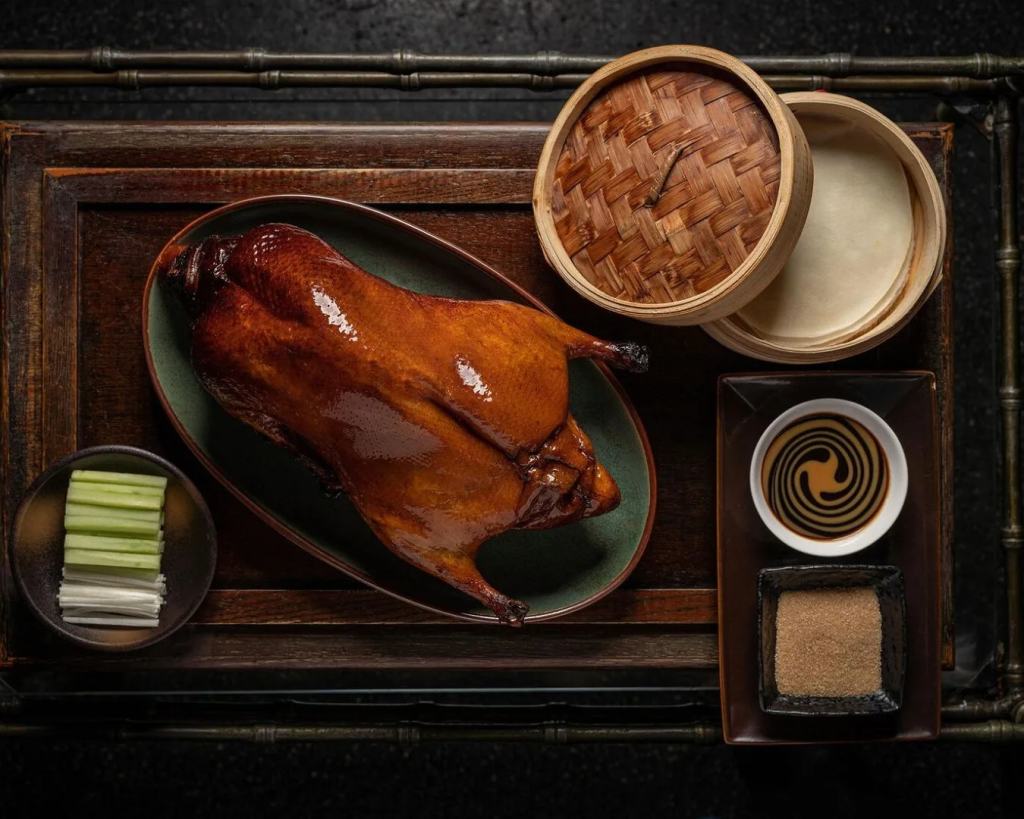
The modern Cantonese restaurant known best for its signature 42-day apple wood roasted Peking duck (carved tableside and considered some of the best in Hong Kong) will offer an array of dim sum, premium beef and seafood, and signature dishes like smoked black cod and Iberico pork char siu glazed with mountain honey, drawing on ingredients and styles from further regions including Shanghai and Beijing.
As part of Crown’s ongoing $200 million redevelopment of it Southbank precinct, waterside pub Bellevue Bar & Terrace will open later this year, with a grill by Victor Churchill and two venues by Las Vegas-based group Clique Hospitality — Amaya Modern Mexican and Barbershop Cuts & Cocktails — to launch in early 2028.
I’ve been to the Expo 29 times so far, and what stays in my memory isn’t only the pavilions — it’s the food experiences.
In this article, I’ll share some of the most unforgettable dishes I’ve tried at the Expo. Each one made me realize, “There are so many amazing local cuisines in the world!”
From surprising flavors to cultural discoveries, every meal was a small journey in itself. I’ll also share some tips on how to get into restaurants smoothly, which might help those planning a last-minute visit.
I hope this guide gives you a taste of the Expo’s global dining adventure before it’s gone.
1) Belgian Mussels — A Meal I’ll Remember for the Rest of My Life
In early September, I went to the Expo with my uncle (79) and aunt (75) — our second visit together. Their biggest wish was to experience food from around the world.
Until then, I had always focused on getting into pavilions rather than restaurants. But this time, I asked a foodie friend who holds a season pass for recommendations. They said, “The Belgium Pavilion is the best.” So right after entering the East Gate at 11:00, we headed straight there. And the result? I’m so glad I trusted that advice — it was perfect!
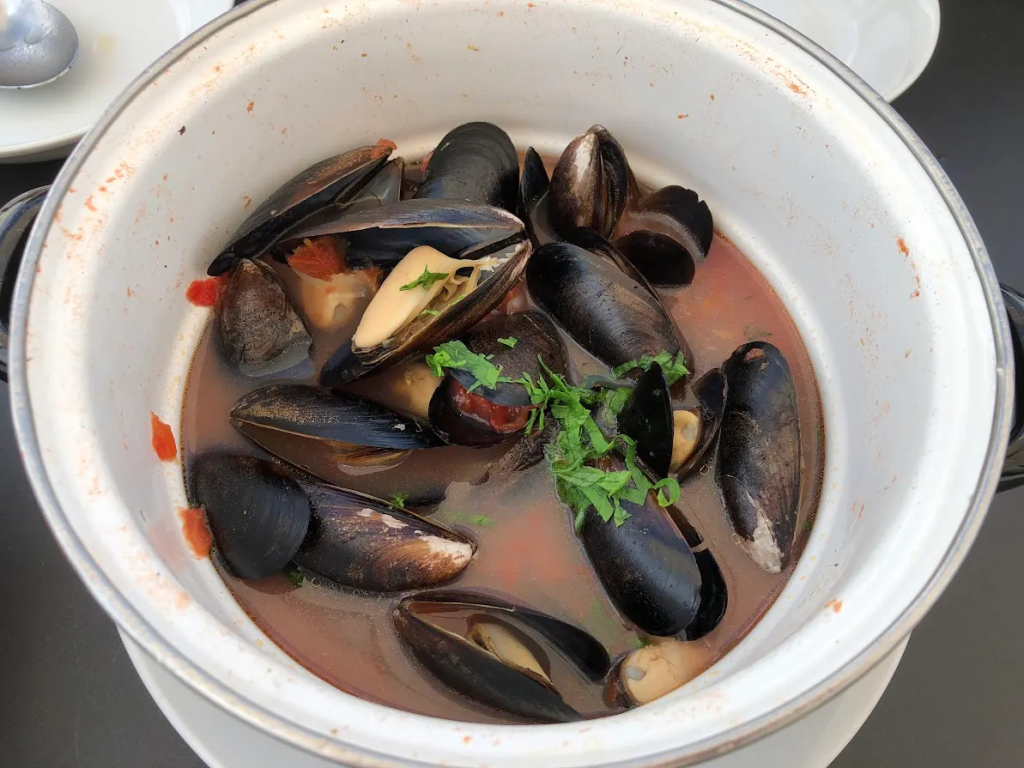
Mussels in tomato sauce (half portion, 500g / about 30 pieces)
You can choose from four flavors — white wine, garlic butter, tomato sauce, and miso cream. We ordered two kinds: garlic butter and tomato sauce. The tomato one, with a touch of celery, was my favorite. A half portion costs ¥2,000, and a full portion is double.
When we arrived, the restaurant line had been temporarily stopped. Then a staff member asked, “Would anyone like an outdoor table?” No one raised their hand — so I did! The weather was perfect, the parasols were large and sturdy, and we had a great view of the Grand Roof Ring. It turned into one of those unforgettable meals where everything — food, atmosphere, and company — aligned beautifully.
I’m sure my uncle, aunt, and I will keep talking about that meal for the rest of our lives. Everything was flawless — taste, mood, and memory. I even thought, “If there were a restaurant like this in town, I’d go for the rest of my life.”
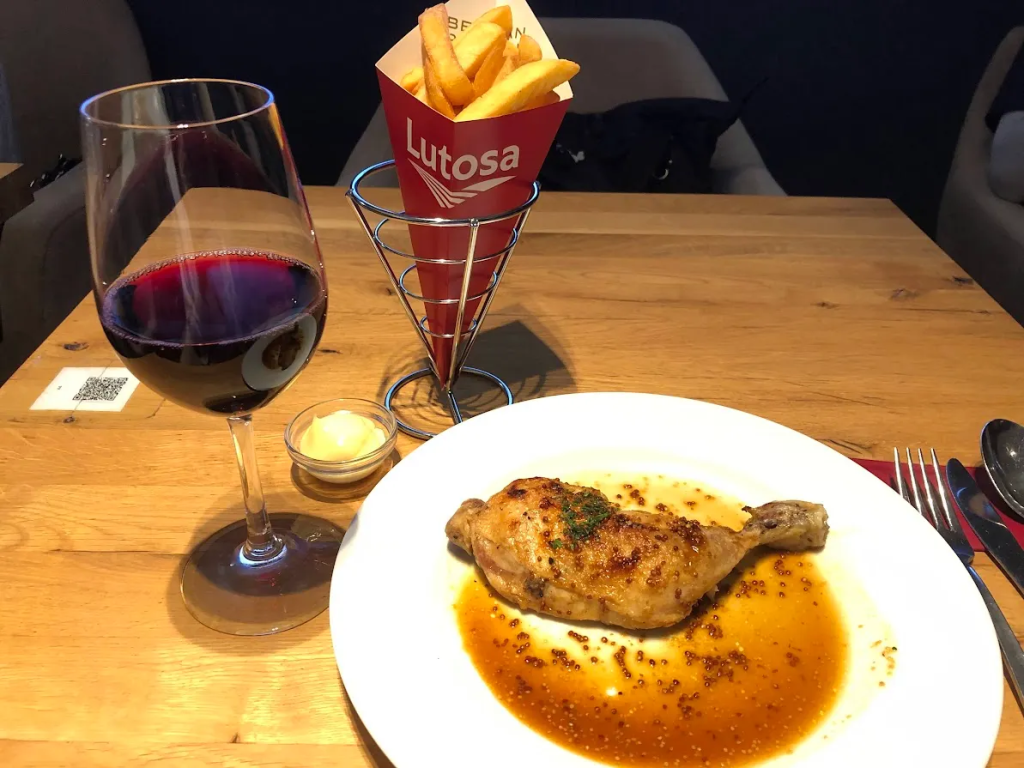
When I visited again alone one evening around 7 p.m., I was lucky to get in. I ordered the chicken confit — perfectly cooked, with a rich balsamic sauce. Every main dish comes with potatoes, and I was completely full. Belgians really do treat potatoes as a staple! Later, I learned that frites — Belgian-style fries — are considered a national dish, typically eaten with mayonnaise. Without realizing it, I had done it the Belgian way.
Most main dishes are around ¥3,000–¥4,000. The chicken confit with wine cost ¥4,180 in total — very reasonable compared to other international pavilions where even a bento can be ¥4,000. To enjoy a hot, perfectly plated meal in such a beautiful setting felt like pure joy. It may sound exaggerated, but dining at the Belgium Pavilion truly felt like a reward meal of my life.
Chicken confit, potatoes, and non-alcoholic wine
I’m not a big drinker — usually just one glass. But the food was so good that I wanted something to go with it, so I tried a non-alcoholic wine. Until then, I had never found alcohol-free drinks delicious in Japan, but that changed here. For the first time ever, I thought, “Non-alcoholic wine can actually taste amazing!” The non-alcoholic beer I had with the mussels was slightly fruity and refreshing — just my taste. Next time, I want to go back alone for the mussels again, with non-alcoholic white wine and fries.
Prices:
Mussels (half, 500g, about 30 pieces): ¥2,000
Chicken confit with potatoes: ¥3,280
Vintens Merlot (non-alcoholic wine): ¥900 / glass
Hoegaarden Zero (non-alcoholic beer): ¥1,000
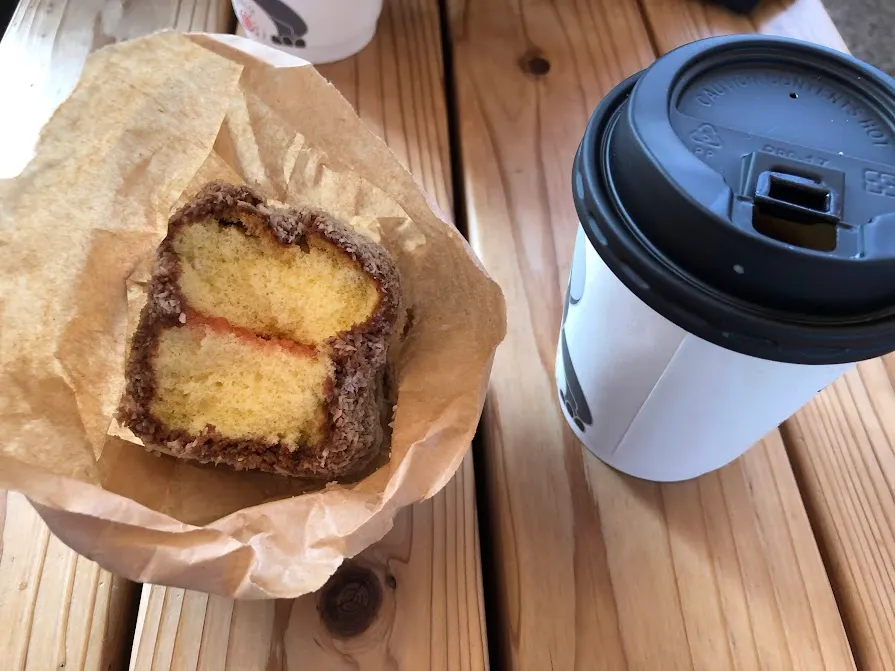
2) Australia’s Classic Dessert — Lamington
Next up is something lighter and easier to grab while strolling around: Australia’s famous dessert, Lamington.
I had seen it on social media and was eager to try. I expected a simple sponge cake at room temperature, but it was delightfully chilled! The coconut flakes outside and the jam inside were both perfectly balanced. I splurged a little and added an iced café au lait — a ¥1,300 treat worth every yen.
Even though the Expo has been packed with visitors lately, the food counter at the Australia Pavilion is surprisingly efficient — about a 5–10 minute wait. With five order/payment counters, it moves much faster than most others.
Prices:
Lamington: ¥650
Iced café au lait: ¥650
A bite of Lamington
3) Tasting the World at Kura Sushi (Osaka–Kansai Expo Branch)
Before the Expo opened, my family bought a guidebook from Pia, and the place that caught everyone’s eye was Kura Sushi (Expo branch). The reason? Besides sushi, you can try signature dishes from over 70 participating countries and regions as side menu items.
Kura Sushi requires reservations, which can be competitive like pavilion bookings. But cancellations or counter openings do happen. I’ve managed to dine there three times out of five attempts — twice solo at the counter and once with a friend at a table. The trick is to avoid peak meal hours.
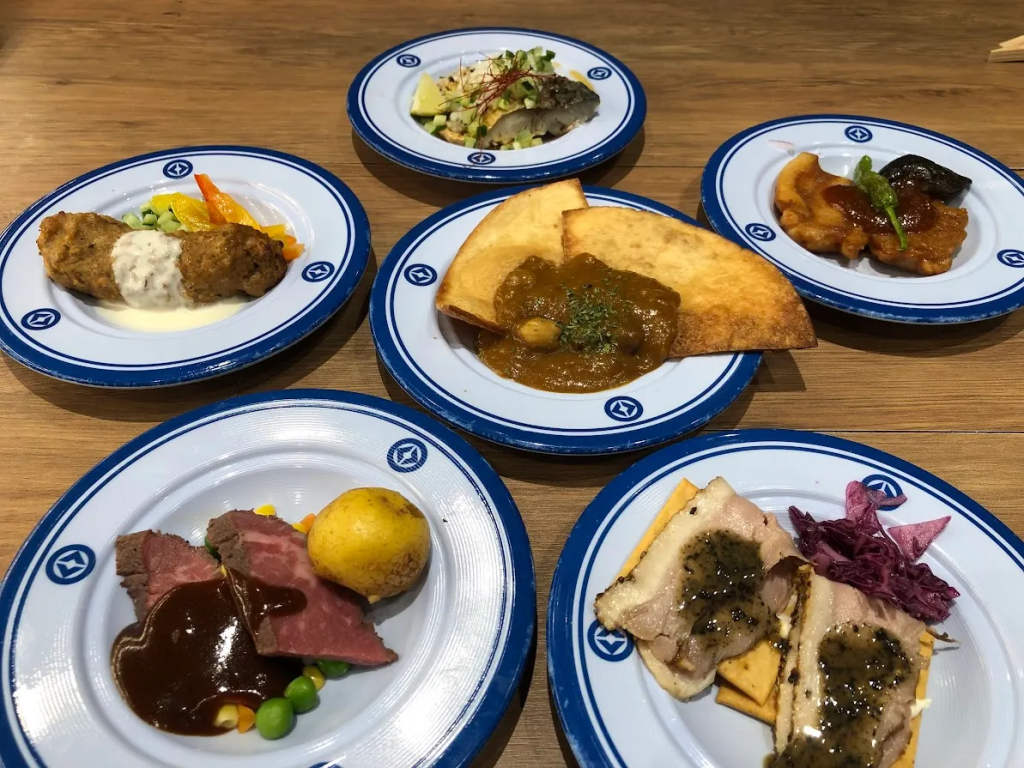
Out of about 20 dishes I tried across three visits, these six stood out:
Makero (Cameroon): Grilled mackerel with spicy chili sauce
Qofte (Kosovo): Spiced meatballs with yogurt sauce
Doubles (Trinidad and Tobago): Fried tortilla with curried beans
Roasted Duck with Truffle Sauce (Hungary): Served with marinated red cabbage
Octopus Salad (Croatia): Marinated in olive oil
Banana Bread Pudding (Yemen): Warm and fragrant with banana and honey
(Reference: Osaka–Kansai Expo Pia Guide, pp. 92–93)
All plates are a flat ¥320 each, regardless of content — some are great deals! Many include two pieces, so sharing doubles the variety you can try.
“World Menu” of global flavors
When my husband and two sons went without me, there was only one open seat. My high-schooler took it, enjoyed dishes from around the world at the counter, and later said, “I’m glad I got to try all those international desserts at Kura Sushi!”
From September 5, three of these special dishes are now being served at Kura Sushi branches across Japan. If you’re curious — give them a try!
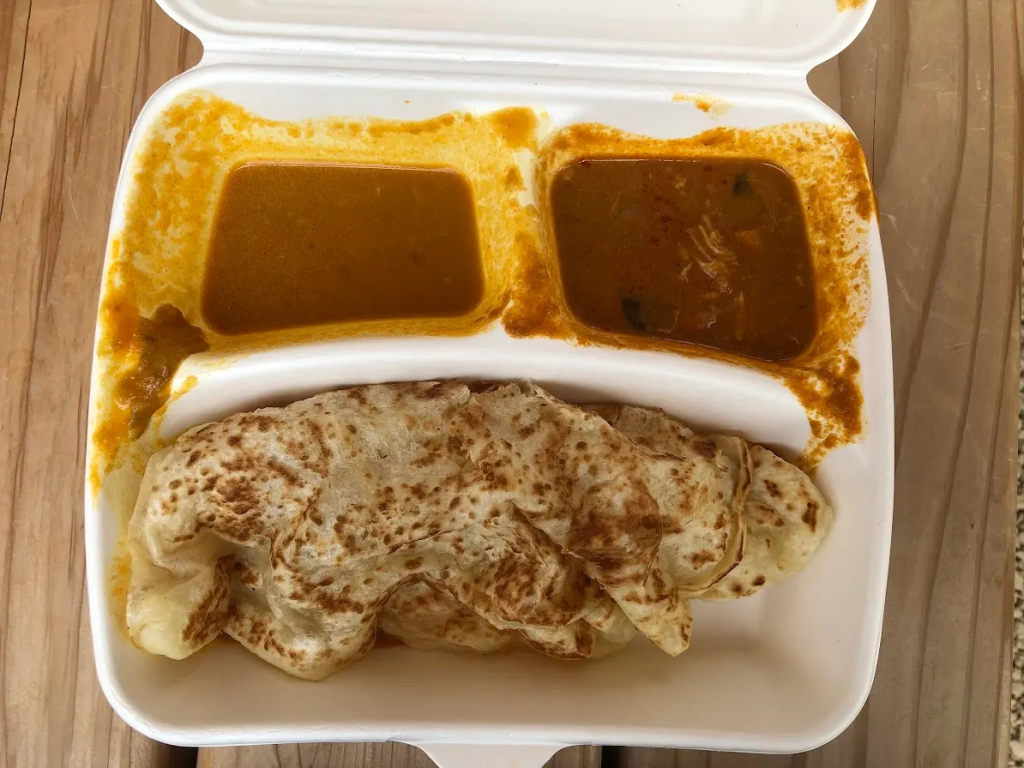
4) Malaysia’s Roti Canai
Next is something both tasty and affordable — Roti Canai from Malaysia’s food counter (with tables and chairs).
I love Malaysia and have spent about a month there during summer vacations for two consecutive years, so I’m familiar with local flavors. Still, when I tried Roti Canai at the Expo, I was pleasantly surprised — so easy to eat and delicious!
It’s different from Indian naan — thinner, flakier, and eaten by hand with curry. It’s light enough for a snack or quick lunch. The Malaysia Pavilion has a large food area on the first floor, open even to those not entering the pavilion. You order at the counter, carry your food yourself, and they serve it in sturdy boxes so you can eat inside or outside.
Price: Roti Canai — ¥1,814
Roti Canai with two types of curry sauces, eaten by hand
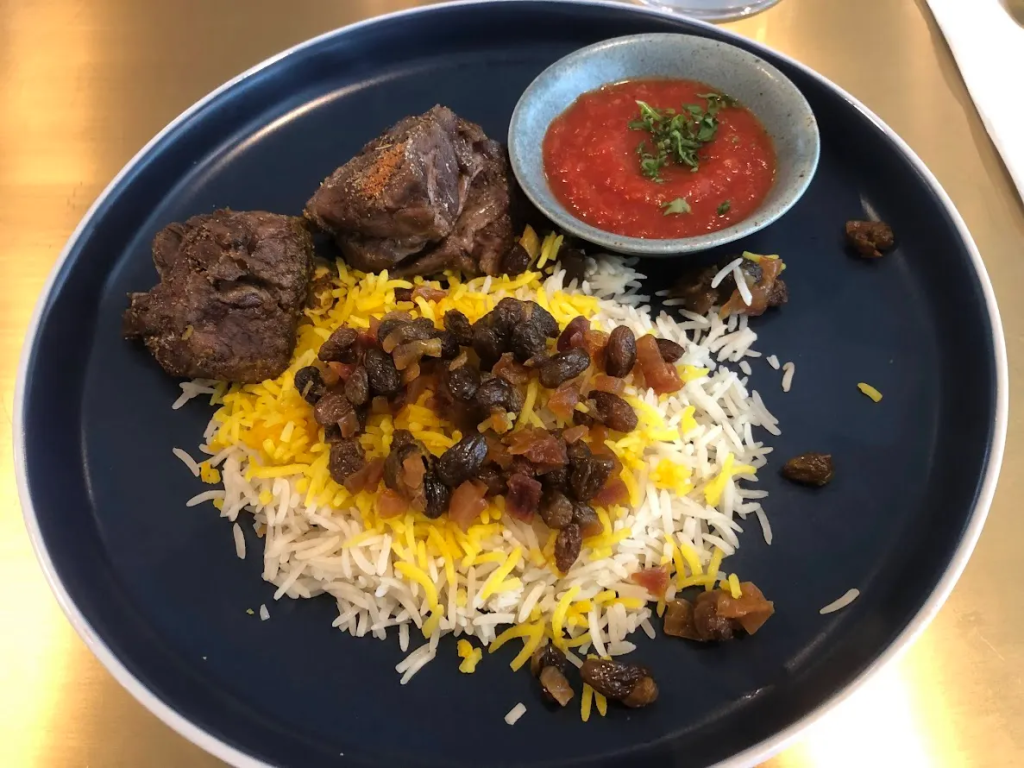
5) Kuwait’s Lamb Machboos
From the start, I’d decided to try dishes from countries far from Japan — foods I rarely encounter in Osaka. The Kuwait Pavilion has a dedicated restaurant, with the pavilion on the left and restaurant on the right. The interior, ceramic plates, and service (including free water) were all excellent.
Since I was alone, I sat at the counter and ordered Lamb Machboos — my first-ever lamb dish. The meat was tender and free of any strong odor, almost melting in my mouth. The tomato-based sauce was mild and delicious — I could’ve eaten more.
When I asked the staff if they often eat lamb, they smiled and said, “Yes, at least once a day — lunch or dinner.” It made me happy to experience Middle Eastern food culture firsthand.
Machboos is a traditional rice dish cooked with lamb, spices, and basmati rice — long, fragrant grains with a completely different texture from Japanese rice. The spice blend includes cardamom, cinnamon, clove, cumin, coriander, turmeric, and paprika — a beautiful harmony of flavors.
When visiting the Expo with a friend, we decided to take a break somewhere — and chose the UAE Pavilion. “Let’s pick a country far from Japan,” we said. After about an hour in line, we got in.
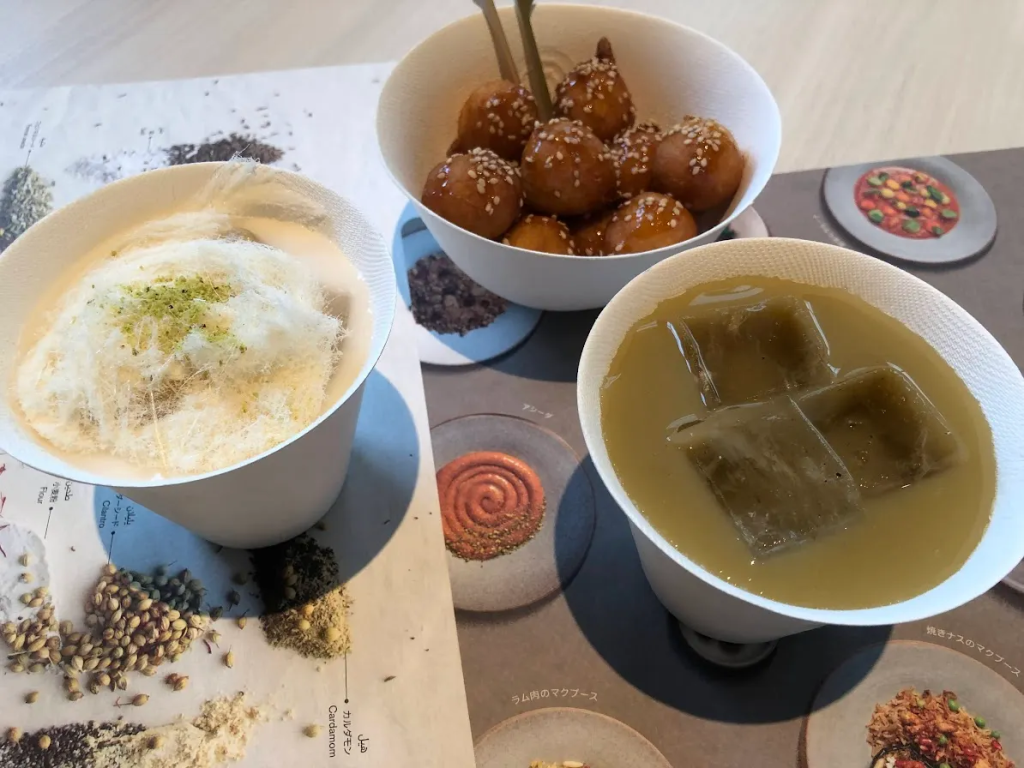
You order at the counter, so we each got a drink and shared a dessert. My friend ordered camel milk, while I chose apple juice. Together we shared Luqaimat, sweet fried dough balls drizzled with date syrup.
Everything was elegant and beautifully presented. The camel milk was fresh and mild, the apple juice naturally tart (no added sugar), and the donuts were simple yet comforting — perfectly paired with the syrup.
Prices:
Donuts with date syrup (Luqaimat): ¥1,600
Camel milk & Rahash: ¥1,000
Apple blend juice: ¥1,000
Donuts, camel milk (left), and apple juice (right)
Through all these dishes — from Kura Sushi’s international bites to pavilions from Asia, Oceania, Europe, the Middle East, Africa, and South America — I feel I’ve traveled the world through flavor.
Every meal brought me closer to the countries behind it. Some, like Belgium’s mussels, became truly unforgettable experiences — ones I now dream of visiting in their home countries someday.
These are the food memories that kept my spirits high throughout the entire Expo season.
If you enjoyed this story, you can read more in my free Osaka–Kansai Expo Guidebook, filled with real stories, photos, and tips from my visits. It’s completely free to read — I hope it helps you make the most of your Expo adventure!
Written by Narumi Ujit
Narumi teaches Japanese and English in Osaka. She writes about Japan’s culture, travel, and everyday beauty — connecting people through language and curiosity.
The findings came as the trade body reiterated a forecast it made in April that food and non-alcoholic drink inflation in the UK will reach 9-10% by December.
More than four in five UK food and drink manufacturers expect to raise prices and a third are planning job cuts, according to a new Food and Drink Federation survey.
Publishing survey findings for the first quarter, the FDF said 82% of businesses expect to raise prices to manage rising costs, while 33% said they plan to restructure or reduce their workforce.
The findings are based on responses from UK food and drink manufacturers of different sizes.
According to the survey, the latest pressure on manufacturers stems from the Iran conflict and the resulting energy shock.
The findings came as the trade body reiterated a forecast it made in April that food and non-alcoholic drink inflation in the UK will reach 9-10% by December.
See Also:
Onus turns on UK government to shield food industry from energy-price shock
GCC trade deal an “exciting opportunity” for UK food and drinks industry, FDF chief says
Citing the International Energy Agency, the FDF said war in Iran “unleashed the worst energy crisis in history, worse than the previous crises of 1973, 1979 and 2022 combined”.
“Higher inflation is unavoidable,” the FDF said, adding that, for the industry, the current crisis is “about higher costs, not shortages”.
Other steps companies said they are taking to manage the impact include changing procurement strategies, cutting marketing expenditure and pausing or cancelling capital investment projects.
Only 21% said they plan to make production more energy efficient.
Business sentiment also weakened sharply. “The industry confidence is in freefall, reaching levels comparable to those seen in the pandemic,” the FDF said.
The FDF’s net confidence score fell to -64% in Q1 from -31% in Q4 2025.
Some 67% of businesses said conditions deteriorated from the previous quarter, while the outlook confidence reading for Q2 was -51%, the weakest since records began in early 2022.
The report said 69% of respondents believe UK government support on energy costs would be the most effective measure to ease pressure on the industry.
For 51% of surveyed businesses, energy accounts for between 5% and 9% of their cost base, while for 8% it represents 20%-24%.
The report also found labour costs are continuing to reshape operations. More than half of respondents said rising labour costs are accelerating automation, while 47% said bonuses were being affected and 36% pointed to pressure on pay differentials.
In a stock exchange filing, the Ukrainian food group said it will buy 70% of Nitsiakos in three stages.
MHP has agreed to acquire a majority stake in Greek poultry producer Nitsiakos in a deal that could eventually lead to full ownership.
In a stock exchange filing, the Ukrainian food group said it will buy 70% of Nitsiakos in three stages.
MHP expects to acquire the first tranche is expected in the first quarter of next year, the second before December 2027 and the third prior to December 2028.
The UK-listed group has also granted the sellers a put option over the remaining 30% stake of Nitsiakos. That option can be exercised between 2030 and 2035.
Nitsiakos, founded in the 1970s and headquartered in Ioannina, is active in poultry, animal feed and pet food.
On its website, the group describes itself as Greece’s “largest” chicken meat producer.
Its facilities include two poultry slaughterhouses with capacity of 41 million chickens a year, a red meat processing unit and a slaughterhouse for turkeys and rabbits.
In 2025, Nitsiakos generated consolidated revenue of about €540m ($629m).
MHP said the amount payable at each stage will be disclosed separately at the time.
The London-listed group entered south-eastern Europe in 2019 through the acquisition of Perutnina Ptuj. It bought Spain’s Uvesa Group last year.
In March, Uvesa announced a deal to acquire Spanish poultry company Payán Hermanos.
Founded in 1953, Payán Hermanos is based in Maracena in southern Spain and sells poultry products in its domestic market.
MHP, founded by chief executive Yuriy Kosyuk, reported revenue of $3.76bn in 2025, up 23.6% year-on-year. Operating profit fell 8.9% to $376m, while profit for the year rose 29.8% to $187m.