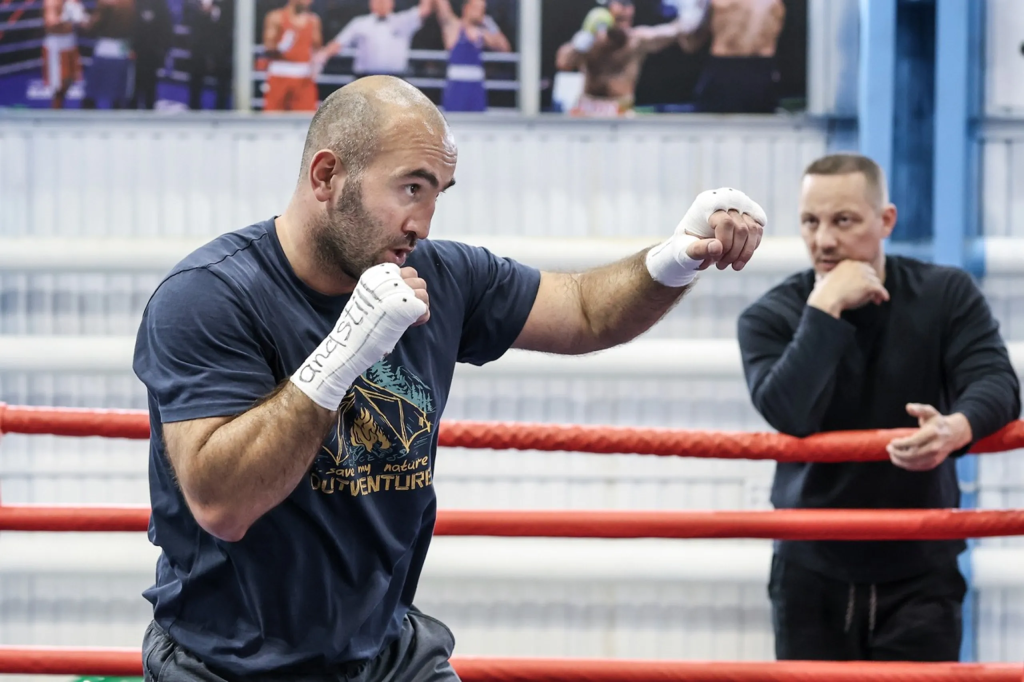
Murat Gassiev trains under the watchful eye of his coach Anton Kadushin.
According to coach Anton Kadushin, the Russian heavyweight is focusing on his ‘competitive mindset’ ahead of his bout with the former French Olympic champion on 11 July in Moscow as part of an International Boxing Association card.
With just over five weeks to go until the first defence of the World Boxing Association heavyweight title he claimed on 13 December, following a sixth-round technical knockout victory over Kubrat Pulev at IBA PRO 13, Murat Gassiev is focusing on his mental preparation.
The victory made Gassiev the first Russian to hold a world heavyweight title in 13 years. The Dagestani fighter has since completed altitude training camps in Terskol and Kislovodsk before moving on to technical and tactical preparations near Moscow.
This phase has also required Gassiev to adapt to a change of opponent after Michael Hunter, his original scheduled challenger, was replaced by Yoka. In response, Kadushin’s coaching team has adjusted its selection of sparring partners to better mirror the Frenchman’s style and physical attributes, with his size and reach allowing him to control distance effectively.
“At this stage, we are focusing on technical and tactical preparation and improving the quality of Murat’s boxing. We are also spending a lot of time working on mentality and competitive mindset,” said Kadushin.
The coach considers mental preparation to be a key factor in ensuring that Gassiev is in peak condition for the fight, which will take place at Moscow’s VTB Arena with the backing of the home crowd. However, he also noted that this increases responsibility and pressure.
For Gassiev, this is a significant opportunity given his status as the Russian world champion, a title he has held for many years. For Yoka, victory would make him the first French boxer to win a heavyweight world title, so it is equally significant for him.
The 2016 Rio Olympic gold medallist brings elite credentials, size and experience to one of the most hotly anticipated heavyweight clashes of the year at IBA PRO 19, an event designed to launch the careers of many fighters.
Physical preparation remains a key aspect of training camp, which will continue until the weigh-in in Moscow the day before the fight. Although Gassiev typically weighs around 110 kilograms outside of training camp, he maintains a fighting weight of 104–105 kilograms under the guidance of strength and conditioning coach Ronald Basiev.
“Murat knows exactly what he can and cannot eat, and he certainly knows how many pies he is allowed,” joked Kadushin, adding that “his nutritional discipline is excellent”.
FISU and WBSC officials during the signing of the MoU in Lausanne.
The International University Sports Federation and the sport’s governing body signed a four-year Memorandum of Understanding on Wednesday to expand both globally by encouraging national federations to include them in their programmes and calendars.
The collaboration takes immediate effect following a meeting between the two organisations at FISU headquarters in Lausanne. Various officials took part in the meeting, led by FISU President Leonz Eder and World Baseball Softball Confederation President Riccardo Fraccari.
“This agreement marks a significant milestone in FISU’s commitment to providing unique sporting opportunities for student-athletes worldwide,” said Eder.
He highlighted the importance of both sports on university campuses and announced they will feature in the programme for the FISU World University Games in North Carolina in 2029. For Eder, the ongoing cooperation “further expands opportunities to enhance the global reach of university sport”.
As part of the MoU, FISU will encourage its member federations and the organising committees of its competitions to include baseball and softball in their programmes, capitalising on the increasing popularity of these sports among young athletes worldwide. The agreement also opens the door to the future inclusion of Baseball5 in the World University Games and University Beach Games.
Fraccari emphasised that the agreement creates “new opportunities for student-athletes to compete, develop and represent our sport internationally, complementing the youth tournaments we already organise”. The WBSC president also noted that his organisation shares values with FISU and that the agreement will help to promote these values, including “education, inclusion and international exchange through sport”.
The WBSC will support the inclusion of FISU competitions featuring baseball and softball in its official calendar, thereby increasing the international visibility of these events. The WBSC currently organises Baseball World Cups in the U-12, U-15, U-18 and U-23 categories, as well as Softball World Cups in the U-15, U-18 and U-23 categories. It also organises Baseball5 World Cups for young people aged 14–18 and an open category for athletes aged 14 and over.
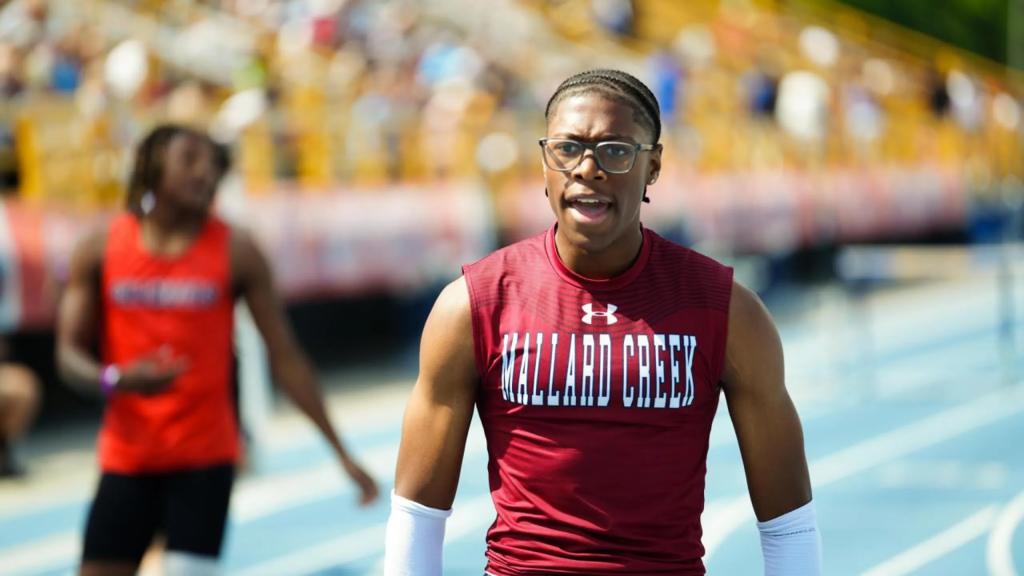
The North Carolina High School Athletic Association has reversed its ban on the Mallard Creek team following runner Nyan Brown’s viral gesture, reinstating the school as co-8A state champion and bringing the dispute to a close.
The decision was taken this week after an emergency meeting called in response to a binding verdict from an independent appeals panel. In a unanimous judgement, the board found the sanctioned athlete, Brown, had engaged in no unsportsmanlike conduct whatsoever.
The dispute began in mid-May at the 8A State Track and Field Championships. With the overall title at stake, the school needed points from the final event, the relay. Brown, running the anchor leg, finished first and raised his left hand, holding up five fingers. Coaches said the gesture was a celebration of the school’s fifth consecutive championship, including indoor and outdoor titles.
A track official interpreted the gesture as taunting and disqualified the team under the federation’s unsportsmanlike conduct rule. The decision removed the ten points awarded for the win and handed the overall state title to C.E. Jordan. Footage of the incident spread online and drew criticism from fans, coaches, and professional athletes, who questioned the severity of the punishment.
With the controversy growing, the case was escalated to the Independent Intercollegiate Track and Field Appeals Board, a three-member body administered by the State Department of Public Instruction. After a two-hour hearing in which both sides gave testimony and video evidence was reviewed, the tribunal found that the school had provided ‘clear and convincing’ evidence that the athlete had not breached National Federation of State High School Associations regulations.
To resolve the matter without altering previously awarded results, school authorities agreed to a compromise. Mallard Creek and C.E. Jordan will share the overall state championship for the season. The points from the 4×400 metres relay were also recalculated, resulting in co-winners for the event: Mallard Creek and Hough High School.
In a public statement, NCHSAA officials said the dispute had been resolved through institutional channels and noted that the process ensured fairness and recognised the sporting efforts of the students involved.
The complication, as outlet NC RunnerS notes, is that NFHS Rule 4-6 is classified under unsportsmanlike conduct and covers a range of actions including taunting an opponent, criticising officials, using offensive language directed at someone, physical contact, or behaviour deemed flagrantly provocative or defiant. Earlier in the day, according to the report, Brown had already drawn scrutiny.
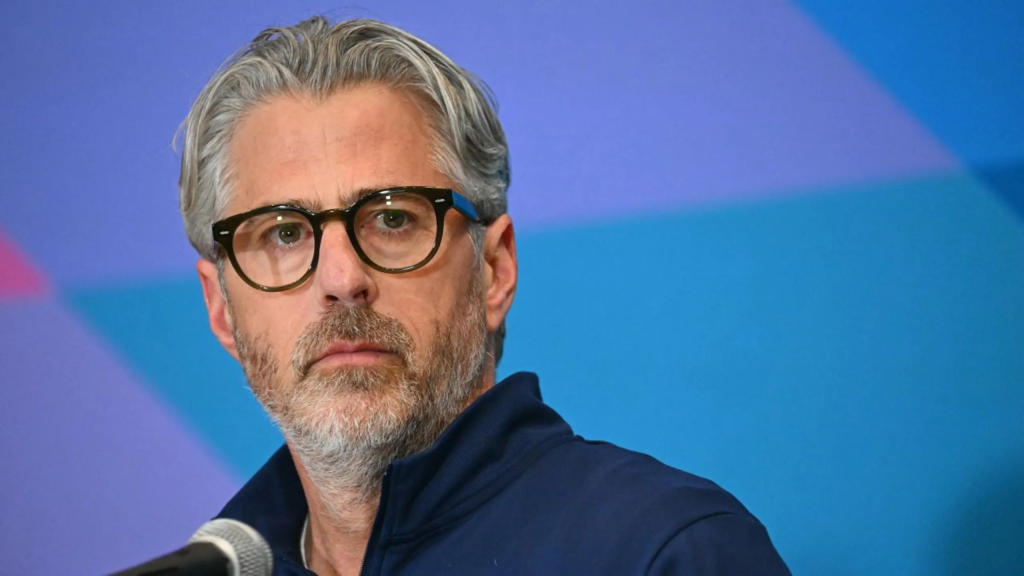
The 2028 Olympics Organising Committee chairman declined to resign Wednesday despite political pressure from the Los Angeles mayor following his appearance in the Jeffrey Epstein files and acknowledged that “maybe Russia and Belarus will come back”.
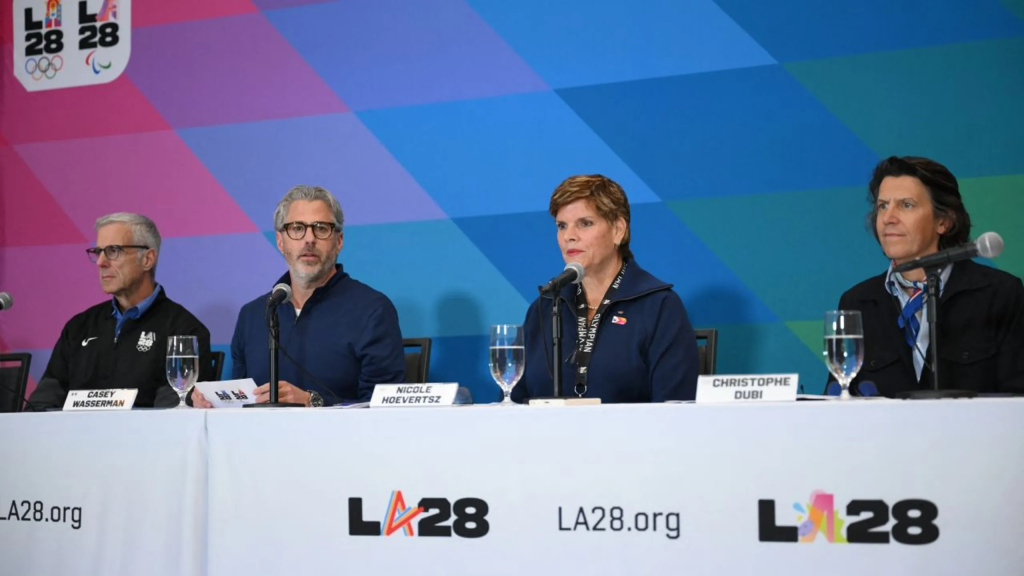
The remarks came at a press conference after the seventh visit of the International Olympic Committee Coordination Commission to Los Angeles, where Casey Wasserman directly addressed the issue that had put his future at the head of the 2028 Olympic project under pressure.
Asked whether he had considered stepping aside and whether he had spoken to Los Angeles Mayor Karen Bass after she called in February for him to leave, Wasserman replied curtly, ‘No and yes’, making clear his refusal while confirming that he has been in contact with the city leader since the controversy spilled over.
The origin of the case lies in documents published by the United States Department of Justice in January, which included 2003 emails between Wasserman and Ghislaine Maxwell, Epstein’s former partner, later convicted of sex trafficking. The documents revealed flirtatious or suggestive exchanges between the two, although the official has not been accused of any offence related to Epstein and has previously maintained that he never had a personal or business relationship with him.
LA28 and IOC hold press conference on 2028 Games plans.
The publication of those documents triggered a public crisis for the LA28 leader, with Bass among the political voices calling for his departure and with pressure also extending to figures linked to his talent agency. The episode threatened to erode the authority of a man who has been one of the main faces of the Los Angeles Olympic project since the bid stage, although the organising committee closed ranks around him.
In January, Wasserman issued a statement saying that he regretted his correspondence with Maxwell and that it had taken place “long before her horrific crimes came to light”. The explanation was the official’s first formal response after his name appeared in the files and served as the basis for the position LA28 has maintained since then: acknowledging the controversy, reviewing the background and maintaining that there were no grounds to remove him.
Shortly after the publication of the documents, LA28 carried out a review, with the help of an external law firm, of Wasserman’s past interactions with Epstein and Maxwell, with the cooperation of the chair himself. The assessment concluded that the relationship did not go beyond what had already been publicly documented, while the Los Angeles Times reported that the executive committee backed his continuation, citing “the strong leadership he has exhibited over the past 10 years”. That support was also expressed by Reynold Hoover, chief executive of LA28, who had already defended Wasserman’s continuation in February and remained firm in that position.
Wednesday, Wasserman tried to present his relationship with Bass as an active institutional one despite the public clash in February. “I talk to the mayor weekly, if not more frequently, and our conversations are between us,” he said. “They continue to be thoughtful and productive with a completely shared vision on delivering the greatest Games for the city and our community.” His message sought to convey that the mayor’s call for his resignation has not broken coordination between the city and the Olympic committee.
After the Detroit Lions broke up their “Sonic and Knuckles” franchise, the club is moving to a one-star show.
The Lions traded hammer David Montgomery this offseason, planning to let speedster Jahmyr Gibbs play the lead role.
“He’s going to be our bell cow now,” coach Dan Campbell said via MLive. “We’re going to hang our hat on him quite a bit. We’re going to do a lot of things we feel like he does well. I’ve mentioned this before, he can run everything that we’ve got. He can run every scheme that anybody’s ever run.”
In his first three seasons, Gibbs dispelled the notion that he’s merely a speed-option, Sonic running around the edge to gobble up coins. The back is an inside-outside nightmare, able to withstand the beating between the tackles while boasting the speed to beat defenses to the edges. His dual-threat ability and the fear his home-run talent instills in a defense make it hard to take him off the field.
Gibbs generated 3,580 rushing yards and 39 TDs in 675 carries over his first three seasons, including back-to-back 1,200-plus-yard campaigns.
The Lions began the transition last year, siphoning off would-be Montgomery carries in favor of Gibbs. The run-game struggles of 2025 compared to 2024 were more due to offensive line issues than the distribution of backfield duties. With Detroit poised to put more on Gibbs’ shoulders, Montgomery requested and received a trade to Houston, where he can get more touches.
Gibbs said not having Montgomery around and being the clear lead-back isn’t odd.
“It’s not weird anymore,” Gibbs said. “It was weird, like when we first got back. But now I’m pretty much used to it.”
He’ll get used to being on the field almost every snap. The Lions added Isiah Pacheco as a sub who can run angry, but his contract — 1-year, $1.81 million — underscores how little Detroit expects to use their backup.
Gibbs will see a huge number of touches, the overwhelming bulk of the carries and is the best receiving option out of the backfield. The Lions should give him the Christian McCaffrey treatment in 2026.
The 24-year-old is on the verge of a payday, one that could reset the running back market. However, Gibbs said he isn’t worried about reaching an extension ahead of the season.
“I’m worried about the team. I’m just tryna hoop right now,” he said. “I let my agent and (GM) Brad (Holmes) do all that — or whoever does it up there, I don’t know. But I just let him do that and I just be out here.”
After his first three years as a duo, Sonic is now the singular title character in Detroit.
The Tennessee Titans added two former No. 17s this offseason, Wan’Dale Robinson, who sported the number in New York, and first-round pick Carnell Tate, who donned it at Ohio State. With All-Pro returner Chimere Dike already holding 17, there were questions about how things would sort out.
Neither newcomer swiped Dike’s number. Robinson wound up wearing No. 4, and Tate, No. 14.
In an interview with Kay Adams on Fan Duel TV’s “Up & Adams” show, Robinson said he never had his eye on No. 17, instead preferring No. 4 to honor his late friend, Rondale Moore, who died in February from a self-inflicted gunshot wound. Robinson and Moore, both Kentucky natives, had been friends for years.
“I didn’t want it,” Robinson said of No. 17. “I was going in wanting a single digit, and then also my late friend, Rondale Moore, he wore No. 4. So that was kind of the reasoning behind me getting that number. Just kind of to honor him and the time that he was here. That’s where I was going in, I wanted No. 4. I don’t know about Carnell and exactly what went on with him and Chim (Dike). But, yeah, I was good with leaving 17 in the past.”
Robinson and Moore, Louisville-area natives who once trained at a facility together, shared a long bond, including both being undersized receivers who propelled their careers to the NFL.
In four seasons donning No. 17 in New York, Robinson worked his way up the ladder, from injury-riddled rookie struggles to top target, and enjoyed his first 1,000-yard campaign in 2025. He moved to Tennessee, rejoining offensive coordinator Brian Daboll, to provide a playmaking slot weapon for Cam Ward. He’ll do so wearing No. 4 to honor his friend.
“Bad Boys” star Theresa Randle is facing new legal issues after her ex filed a restraining order claiming she broke into his home and desperately needs help … TMZ has learned.
TMZ obtained the petition filed by Theresa’s ex, Dario Pallini, who claims the the 61-year-old actress — who also appeared in “Malcolm X” — has been harassing him since their 2024 split.
Pallini, who says he dated Theresa for two years, claims she broke into his home on June 1, when he came home to find her “sitting in my closet with my dog” and “smoking crack.” He says she was “surprised I was there and said that she thought I was in jail.”
He says he told Theresa she needed to leave, but claims she “began saying things that didn’t make sense” and told him “‘she doesn’t bow down to no man, you Aryan piece of s***.’”
Per the petition, Pallini threatened to call the cops, which he says led to her throwing a can of vegetables at him, hitting him in the head.
Pallini says he then called police, who made her leave. Still, he says he is afraid she will come back and break in.
n his filing, Pallini claimed there was another incident on May 18, when he woke up to find her in his apartment. He says he could “tell she was high because she started to clean my house and telling me that I owe her.”
He claims she threatened to shoot him and then grabbed a pole that was part of his medical bed and swung it at his head. He says she hit him in the shoulder before he was able to grab the pole from her … adding she was arrested that night, as well.
Pallini ends by telling the judge, “She is addicted to drugs and needs help.”
The judge has granted the temporary restraining order with a hearing date set for June 23.
As TMZ first reported, Theresa was booked on March 1 on a felony corporal injury charge … but the case was later dropped. The actress was previously arrested in October 2024 on assault charges. The DA ended up not pressing charges in the case.
The ‘it’ girl reflects on the era-defining series as Sydney Sweeney reveals why she didn’t want to ‘curl up in a ball and disappear’ during sex scenes.
“B*tch, you’re my soulmate.”
The line that Alexa Demie’s Maddy famously delivered to Sydney Sweeney (Cassie) in the first season of Euphoria came full circle during the era-defining show’s final season, where the pair’s competitive, on-again/off-again friendship remained a major focus.
And while the fate of Zendaya’s character Rue came to a tragic conclusion with her fentanyl-laced overdose, the 93-minute finale, ‘In God We Trust’ – which aired Monday – left the futures of Sweeney and Demie’s characters hanging in the balance.
Since the finale, Euphoria creator and writer Sam Levinson has confirmed there will be no more episodes of the hit series, telling The New York Times: “In terms of the story that we set out to tell, which is a story about addiction and its consequences, this feels like the end to me.”
But it didn’t feel like the end for Sweeney and Demie, the undisputed fashion and beauty icons of the series. Following the bloodbath at the Silver Slipper, what became of Maddy? Did she take up with Bishop? Was Maddy and Cassie’s Playboy-style influencer house actually a success? And would the dark truth surrounding Nate’s death ever be revealed?
For Demie and Sweeney, Euphoria felt like a defining moment long before this final chapter. In 2022, this writer sat down with the actors and their co-star Maude Apatow – who played Cassie’s straight-laced sister Lexi – to ask for their reflections on several aspects that made Euphoria such an social media-fuelled hit.
The trendsetting beauty aesthetic. Those graphic sex scenes. And its portrayal of adolescence’s dark realities, which struck a nerve with viewers and ultimately proved a hauntingly accurate prediction of what was to come.
Hunter Schafer, Alexa Demie, Sydney Sweeney and Maude Apatow.
“B*tch, you’re my soulmate.”
The line that Alexa Demie’s Maddy famously delivered to Sydney Sweeney (Cassie) in the first season of Euphoria came full circle during the era-defining show’s final season, where the pair’s competitive, on-again/off-again friendship remained a major focus.
And while the fate of Zendaya’s character Rue came to a tragic conclusion with her fentanyl-laced overdose, the 93-minute finale, ‘In God We Trust’ – which aired Monday – left the futures of Sweeney and Demie’s characters hanging in the balance.
Since the finale, Euphoria creator and writer Sam Levinson has confirmed there will be no more episodes of the hit series, telling The New York Times: “In terms of the story that we set out to tell, which is a story about addiction and its consequences, this feels like the end to me.”
Alexa Demie. Picture: Brianna Bryson/WireImage
But it didn’t feel like the end for Sweeney and Demie, the undisputed fashion and beauty icons of the series. Following the bloodbath at the Silver Slipper, what became of Maddy? Did she take up with Bishop? Was Maddy and Cassie’s Playboy-style influencer house actually a success? And would the dark truth surrounding Nate’s death ever be revealed?
For Demie and Sweeney, Euphoria felt like a defining moment long before this final chapter. In 2022, this writer sat down with the actors and their co-star Maude Apatow – who played Cassie’s straight-laced sister Lexi – to ask for their reflections on several aspects that made Euphoria such an social media-fuelled hit.
The trendsetting beauty aesthetic. Those graphic sex scenes. And its portrayal of adolescence’s dark realities, which struck a nerve with viewers and ultimately proved a hauntingly accurate prediction of what was to come.
Hunter Schafer, Alexa Demie, Sydney Sweeney and Maude Apatow. Picture: Getty Images
Long before the final credits rolled, Sweeney told this writer how she wanted the series to be remembered: “I think 20 years from now … people are like, wow, that show really holds up.
“I hope it’s a generational show. When you think back, you’re like, oh, that time is Euphoria.”
Down is up. Right is left. The future is the past. Nothing makes sense.
In Game 2 of the Stanley Cup Final, the host Carolina Hurricanes trailed by two goals, scored three straight to take a lead in the third, lost that lead only to win 4-3 in overtime against the Vegas Golden Knights.
Both of the first two games really came alive once the regulation clock was within the last five minutes. Now the setting shifts to Las Vegas for Games 3 and 4, with the Cup Final resuming Saturday.
Every game comes with its own set of questions and thoughts to ponder. This one had a lot of them. Here’s a look at how both teams influenced the momentum of the game, the players to watch going forward, along with the looming questions heading into Game 3.
Carolina Hurricanes Grade: B
Perhaps the easiest way to dissect this game is to look at how the Hurricanes performed in the first 50 minutes versus what happened afterward. The first 50 minutes was an extremely complicated scenario. The Hurricanes found what could be deemed success in preventing the Knights from consistently generating shots and scoring chances; the blemishes were the two goals by Brett Howden.
What overshadowed that defensive effort was how the Hurricanes had a first-period shot share of 82.1%. The top-six forward group featuring Sebastian Aho, Jackson Blake, Nikolaj Ehlers, Taylor Hall, Logan Stankoven and Andrei Svechnikov each had a shot share that was greater than 60% — only to come away with nothing. It also didn’t help that Alexander Nikishin was the only member of the Canes blue line who recorded a shot on goal by midway through the third period, an odd occurrence for a team that had four defensemen finish with more than 30 points in the regular season.
Then came the time after the initial 50 minutes. The Hurricanes broke out for three unanswered goals in the span of five minutes. One of them was from Stankoven, who won a puck battle to get his team on the board, before Mark Jankowski tied it a little more than two minutes later. Goaltender Frederik Andersen’s efforts were important throughout, but the stability he provided became even more crucial when he made the sprawling save on Ivan Barbashev that led to Vegas coach John Tortorella using a challenge because he believed the puck went in before the play was whistled dead. His challenge failed, the Hurricanes went on the power play for the delay of game, and Jordan Staal scored with less than five minutes left for a 3-2 lead.
With the momentum and the crowd back on the Canes’ side, Blake was assessed a minor penalty for interference. The Canes killed it off, but the Golden Knights tied it on a 6-on-5 just eight seconds after the Hurricanes returned to full strength.
The final turning point of the game was the result of Tomas Hertl being called for tripping. That led to Seth Jarvis, who has been part of that much-maligned top line that hadn’t scored coming into this series, scoring the winning goal in overtime.
Vegas Golden Knights Grade: B-
Similar to the Hurricanes, the Golden Knights’ performance in Game 2 can be viewed through two prisms.
The first being how they needed their defensive structure to overcome an offensive system that greatly struggled. It started with having those two-way centers such as Jack Eichel and William Karlsson who can be paired with two-way wingers such as Mitch Marner and Mark Stone, which allows their forwards to remain steadfast in their defensive approach — especially during extended time when they don’t have the puck.
Brayden McNabb’s injury forced Tortorella to make lineup adjustments. Rasmus Andersson and Noah Hanifin gave the Golden Knights a consistent defense pairing, and Shea Theodore played 28:30 and Jeremy Lauzon finished at 21:08. The Knights had 25 blocked shots and forced one giveaway in a game in which they struggled for goals and scoring chances aside from Howden’s efforts.
That leads to the second prism being Tortorella’s challenge on the potential Barbashev goal — and the ensuing power play for the Canes. Carolina had failed to score on its first four power-play chances this series before Staal’s goal that gave the Canes a late lead in the third. For a time, it appeared that Tortorella’s decision to challenge was going to doom the Golden Knights.
Stone’s net-front goal tied the score to force overtime, but any chance of taking a 2-0 series lead was erased after Hertl’s penalty and Jarvis’ winner.
Players to watch in Game 3
Andrei Svechnikov LW, Hurricanes
This is going to be a talking point until it’s not. And the “this” in this case is how the Canes are struggling to receive offensive contributions from certain members of their top six.
Svechnikov is one of the players who has faced the most scrutiny. The 6-foot-3 winger had the strongest regular season of his career, with 31 goals and 70 points. He was part of an offensive phalanx that saw the Hurricanes enter the playoffs with seven players who had 20 or more goals, and 13 who reached double figures.
Forget the fact that Svechnikov hasn’t scored a goal in the Cup Final. He had only one shot in Game 1, and came into the third period without a single shot in Game 2. Svechnikov finished with no shots and one assist.
Brayden McNabb D, Golden Knights
Is he going to be available for Game 3, or will Tortorella need to make an adjustment with his defense pairings?
As he has done all postseason, McNabb blocked a shot, but this time it was with his face and it led to him leaving the game bloodied. ESPN’s Emily Kaplan reported McNabb was seen leaving the building and was taken to a local hospital.
Losing McNabb for the rest of the game meant the Golden Knights were without one of their top-pairing defensemen who had been so crucial. In the event he can’t play Saturday, the Golden Knights could turn to seventh defenseman Ben Hutton, who has already played seven times this postseason, or Kaedan Korczak, who has played in 12 games in this playoff run.
Big questions for Game 3
Will the supporting cast make the difference going forward?
In Game 1, Staal’s goal tied the score at 3-3 before Shayne Gostisbehere got the salvo that tied it at 4-4. In Game 2. Stankoven scored the goal that cut the lead in half, and Jankowski, a bottom-line forward, scored the tying goal before Staal scored what was a temporary go-ahead goal.
That’s four goals — Gostisbehere and Jankowski, along with two from Staal — of the eight that Carolina has scored in the Final that have come from beyond their top-six forward group. One of the details that made the Hurricanes different compared to previous season was how they could get goals from different sources.
Could that continue in Game 3 and beyond? If so, will it be one of the factors that gets them the elusive Stanley Cup they’ve been seeking since 2006?
Can they get a quicker start in the offensive zone?
Finishing the first period with a 50% shooting percentage sounds great until you realize it was on only two shots.
In the Rod Brind’Amour coaching era, the Hurricanes have been one of the best teams in the NHL at suppressing offensive opportunities for opponents. But the Golden Knights came into the Cup Final averaging the second-most goals per game and showed in Game 1 they could score when they dropped five to take a 1-0 series lead.
But even in that high-scoring effort, the Golden Knights had only four shots in the first period before scoring four times on 19 shots. Having Howden score twice while others were trying to find some sort of consistency was crucial. But giving up those three goals in row late in the third period of Game 2 meant they had to suddenly find counters to problems they struggled to answer all night.
Stone scored another clutch goal to send the game to OT, but questions remain as to what Knights will do to get off to a faster start, knowing that another frantic finish could await in Game 3.
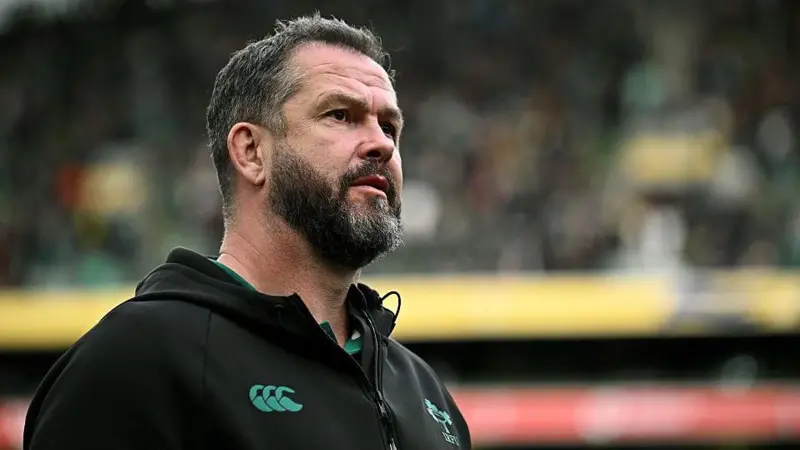
Farrell was Ireland’s defence coach before taking over as head coach seven years ago
Ireland men’s head coach Andy Farrell has signed a contract extension with the Irish Rugby Football Union (IRFU) until 2031.
The 51-year-old replaced Joe Schmidt after the 2019 World Cup – having spent three years in the New Zealander’s backroom – and has led Ireland to two Six Nations titles, including Grand Slam in 2023, and a historic Test series win over the All Blacks in New Zealand.
Farrell temporarily stepped away from the Ireland job at the start of 2025 to take over as British and Irish Lions head coach and the tourists to a Test series win over Australia before returning to Dublin.
Earlier this year, the 2023 World Rugby coach of the year was linked with a return to Saracens, where he previously played and coached, which prompted an angry response from the Prem club.
But speaking in March, Rugby Football Union boss Bill Sweeney said England’s governing body was “not in a dialogue” with Farrell.
After autumn defeats by New Zealand and world champions South Africa, a dismal opening Six Nations loss to France in Paris increased the pressure on Farrell, but victories over Italy, England, Wales and Scotland secured the Triple Crown and pushed Les Bleus all the way in pursuit of the championship.
His current contract with the IRFU was due to expire after the 2027 Rugby World Cup, but the former England international will now lead Ireland to the following tournament which will be held in the USA.
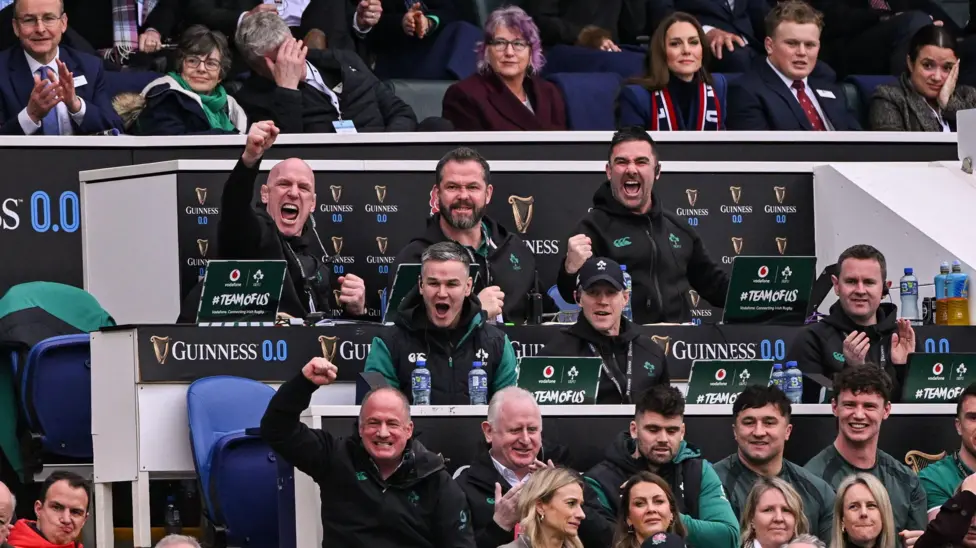
Farrell and his backroom team masterminded a 42-21 win over England at Allianz Stadium earlier this year
Farrell said he was “incredibly proud to continue this journey” with Ireland.
“It is a privilege to work with such a talented group of players and staff, and to represent the supporters whose passion and unwavering support drive this team forward and inspire us every time we take the field,” he said.
“What excites me most is the increasing strength and investment in pathways and the quality of talent coming through.
“There is a real confidence in the system that has been built across the provinces and age-grade programmes, and I believe with sustained effort that the best is yet to come.”
IRFU chief executive Kevin Potts said the organisation is “delighted” to tie Farrell down to a fresh deal.
“He is a truly world-class coach and an exceptional leader who has helped shape Ireland as one of the most exciting and consistent teams in the world,” said Potts.
“His impact reaches far beyond what we see on the pitch – he has instilled a deep sense of pride, connection, inspiration and belief across Irish rugby, creating a culture that truly unites players and supporters and one that Irish Fans at home and across the globe feel incredibly proud to stand behind.”
Farrell’s immediate priority is finalising his squad for the inaugural Nations Championship, with Ireland facing Australia and Japan in Australia on 4 and 11 July before taking on the All Blacks in New Zealand on 18 July.
‘Huge news for Irish rugby’
While this is huge news for Irish rugby, it has significant ramifications elsewhere.
Farrell would have been the RFU’s number one contender to succeed Steve Borthwick as England boss – whenever that might be – while he was also a target for Saracens.
He might still coach England again one day – he is only 51 – but for now he has decided to stay in a place where he is settled and revered, and will have two more cracks at the World Cup with Ireland.